
Life at the dig
Angeac-Charente · July 2026
Early in the morning, coffee is brewed under the main tent. Nearby, tools are ready and fossils emerge from the clay. At Angeac, we share more than an excavation: research, practical skills and daily life.

01 · From the village to the dig
The camp wakes up
During the field season, we camp in Angeac village on land beside the church. The village hall is our other meeting point: we prepare meals there and gather for dinner.
Each morning, we reach the site early. Some have breakfast at the village hall and others at the dig. Under the main tent, the first pots of coffee mark the start of the day.


A place to gather
Around the same tables
Throughout the day, the main tent is the centre of our shared life. We eat lunch, take breaks and discuss the morning’s observations there. Conversation moves naturally from a newly found fossil to life at camp.
These moments are as much part of the dig’s spirit as the hours of excavation: we get to know one another, help each other and become a team.
Working close to the clay
Patience, care and shared knowledge
In the excavation areas, we expose fossils with tools ranging from robust implements to delicate instruments. We observe their positions, record the pieces and work together, taking time to understand what the ground reveals.
Skills are shared daily among researchers, students, excavators and volunteers. Advice, a demonstrated technique or a shared observation: research also develops through these exchanges.

02 · An organised excavation
Four spaces, one shared endeavour
Equipment, washing, public outreach and fossil study each have their place. We move between them during the day: three dedicated tents and a study area in the main tent.

Equipment
One tent is dedicated to excavation equipment. Tools, accessories and supplies are organised there to support fieldwork.

The fossil workshop
Under the workshop tent, we wash fossils and arrange them in trays. This patient work makes surfaces easier to read and prepares the specimens for study.
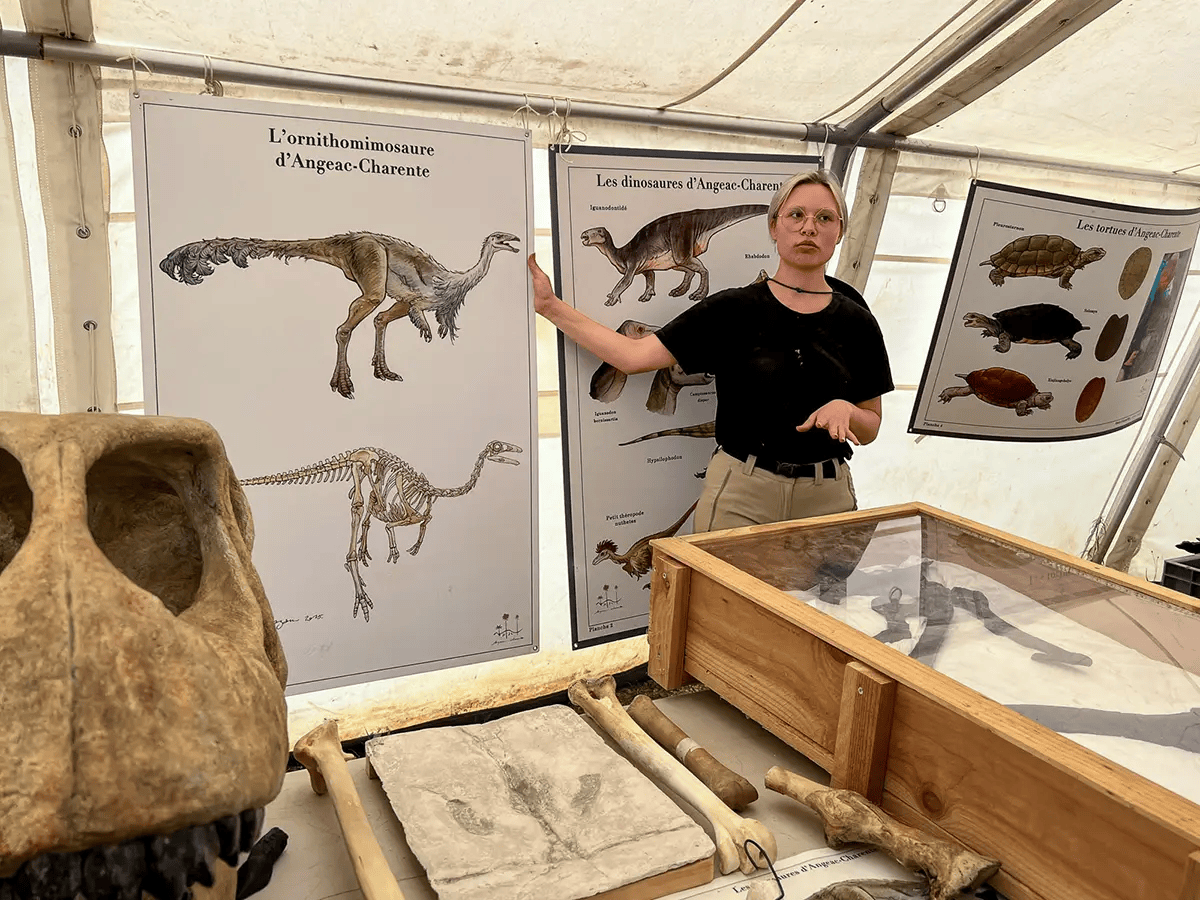
The small museum
In a tent dedicated to visitors, we tell the story of Angeac and present the animals that inhabited this environment. Fossils and illustrations support the excavators’ explanations.

The study area
At the front of the main tent, an area is reserved for studying newly discovered fossils. A microscope and laboratory instruments help us examine and identify specimens.
The fossil workshop
From washing to first observations
In the workshop, specimens move through trays and worktables. We remove clay to examine surfaces and distinguish the shapes revealed by excavation.


03 · Excavation techniques
Reading the ground, piece by piece
Before entering the collections, every discovery belongs to a context. We expose specimens, observe their relationships and record the information needed to study them after the field season.
Bones, teeth, plants and the smallest remains help reconstruct Angeac’s environment. Sieving and sorting clay complement excavation: part of this lost world is hidden in tiny fragments.


Work continues after exposure
Clean, observe, understand
Washing makes surfaces easier to examine. Around the trays and tables, we care for newly uncovered material and share observations. The workshop is also a meeting place where techniques are passed on.
Excavation is only the beginning: preparation, conservation and research continue long after summer.

In the main tent
Microscope observations and the study of discoveries
At a front corner of the main tent, we have a study area with a microscope and other laboratory tools. We examine newly found fossils to identify details, compare specimens and refine their identification.


04 · Sharing research
An excavation that welcomes curiosity
During the field season, visitors come daily to discover the excavations. In the small museum, an excavator explains Angeac’s history using fossils and illustrations. The tour continues beside the excavation areas, close to the work in progress.
Seeing an excavation reveals the patience, range of tasks and steps that connect a trace in clay to the history of life.
05 · Living together
Camp life beside the water
The lake is part of the everyday landscape. During breaks, it offers a change of view from the excavation area; some team members occasionally go for a swim.
In the evening, we return to the village. Meals prepared for the team bring everyone together at the village hall. Afterwards, each person returns to their tent near the church before another morning in the field.

The dig in drawings
Through Isabelle Dethan’s eyes
Isabelle Dethan’s drawings capture postures, makeshift shelters and the relationships formed around the dig. Her work follows everyday activities and preserves the memory of this shared experience.

When the rain arrives
Sheltering the equipment, then gathering together
A shower quickly changes the pace of the dig. Everyone gathers equipment, protects tools and moves supplies under the tents. Once everything is sheltered, the team gathers there too until the rain passes.
These moments are part of our shared life: helping each other, moving what needs protection and waiting together before resuming work.

The end of the season
The water returns as the dig closes
At the end of each campaign, water is pumped back to cover the excavated areas. The fossils and excavation grid remain submerged and protected until the next season.

Watching the water slowly rise is a powerful moment for those who worked here. The excavation gradually disappears beneath the surface: the end of the season becomes visible, and it is time to say goodbye.
For two days, work continues in a different form. Equipment is cleaned, organised and packed into crates, and the tents are dismantled. People leave in turn, saying goodbye to a place that shaped their days and held the summer’s discoveries.
An endeavour that brings us together
The pleasure of being together continues through La Confrérie du Grand Sauropode, its gatherings and banquets.
