
Comparative anatomy and dinosaur evolution
Diversity of life
Identifying, comparing and investigating relationships
An isolated bone or tooth may preserve useful characters, but not every discovery permits equally precise identification. Comparative anatomy examines these characters and compares them with other specimens.


The method in practice
Researchers describe specimens, identify structures, compare proportions and assess the effects of age, individual variation and preservation. Analyses of evolutionary relationships rely on sets of characters; one striking feature cannot replace that comparison.
At Angeac and in regional comparisons
Angeac dinosaurs include sauropods, ornithomimosaurs, stegosaurs, ornithopods and predatory theropods. Some are represented by numerous bones, others mainly by teeth. The quantity and nature of available specimens determine the comparisons possible and the precision of identification.


Comparing sauropods beyond their silhouettes
A long neck, small head and long tail are not enough to identify a sauropod. Skeletal proportions, skull shape, teeth and vertebral characters provide more precise comparisons. Drawings help locate these regions; identification rests on the fossils.
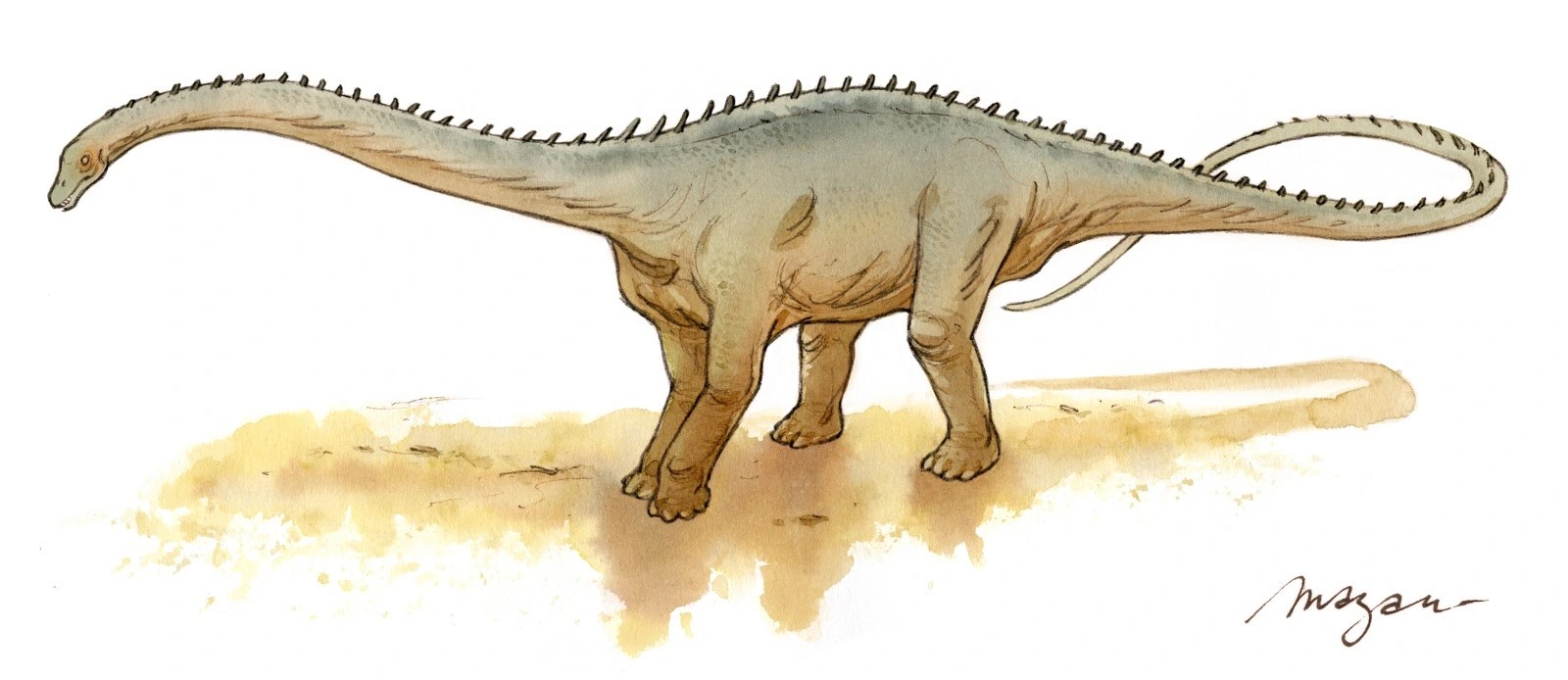

These two illustrations are not to the same scale. The first depicts another sauropod; the second places bones within a proposed skeleton. They help explain anatomy without confusing a complete reconstruction with the amount of fossil material actually recovered.
What this research reveals
The same approaches connect studies of sauropods, ornithomimosaurs, other ornithischians and predatory theropods. Observed characters are assessed against available comparisons, supported by imaging and morphometrics.
Research published in 2026
Different teeth in the same jaw
The study of 167 isolated teeth from the Angeac turiasaur identifies five morphotypes linked to their position in the jaw. Comparative anatomy and 3D morphometrics work together to classify teeth and resolve ambiguous cases.
Clémence Le Gouellec, Ronan Allain, Jean Goedert, Romain Pintore, Jackson Carter, Rafael Royo-Torres, Dominique Augier and Raphaël Cornette, Journal of Anatomy, 2026.
Examining the evidence
Comparing bones and their context
Accumulations of fragments lie alongside associated or isolated bones. Three left ornithomimosaur tibiae differ in size. Sauropod femur ANG 10-400 measures 2.20 metres long.

Position in the ground and associations between specimens complement anatomical shape: both approaches are needed to interpret an assemblage.
Specimens and data
Comparing vertebral characters
View the ornithischian plates → · Compare theropods →
Sauropod vertebral shape illustrates comparisons of anatomical characters. Ornithischian teeth and bones appear on the page devoted to that group. Each identification relies on a set of characters.
Enlarge each plate to examine labels, specimen identifiers and scale bars.

People and expertise
Ronan Allain studies Angeac dinosaur anatomy and evolution. Other specialists contribute according to the specimens and methods involved, particularly teeth, growth and shape variation.
Further reading
Overview reference: Dinosaures, les géants du vignoble (2017), p. 200–225.
Publications and results → · The book and its authors →
Scientific research on this topic
- 2026 · Intraspecific and interspecific variation in sauropod teeth from Angeac-Charente (conference contribution)
- 2013 · Comparing European and Asian dinosaurs: Angeac and Laos (conference contribution)
- 2026 · Heterodonty in turiasaur teeth (article)
- 2023 · Femoral variation and the hypothesis of sexual dimorphism (article)
- 2022 · Vertebrate diversity across the Jurassic–Cretaceous transition (article)
- 2014 · European ornithomimosaurs: reassessing the record (article)
