
Sauropods
Giants of the vineyards
Fossils from Angeac-Charente attest to at least two lineages of herbivorous sauropods: a turiasaur whose remains have been collected since 2010, and a macronarian close to Camarasaurus, discovered in 2024.

Two sauropod lineages at Angeac
The turiasaur, known since 2010
Since the first excavation campaigns, large femora, teeth and many other bones have attested to a turiasaur at Angeac. These fossils are assigned to Turiasauria; their species remains undetermined.
Research on turiasaurs brings together Rafael Royo-Torres and the Teruel-Dinópolis teams. Comparisons between fossils from Angeac and the Iberian Peninsula refine our understanding of the anatomy and evolution of this sauropod group.
Meet Rafael Royo-Torres → · Dinópolis and Teruel →

2024: the discovery of a different sauropod
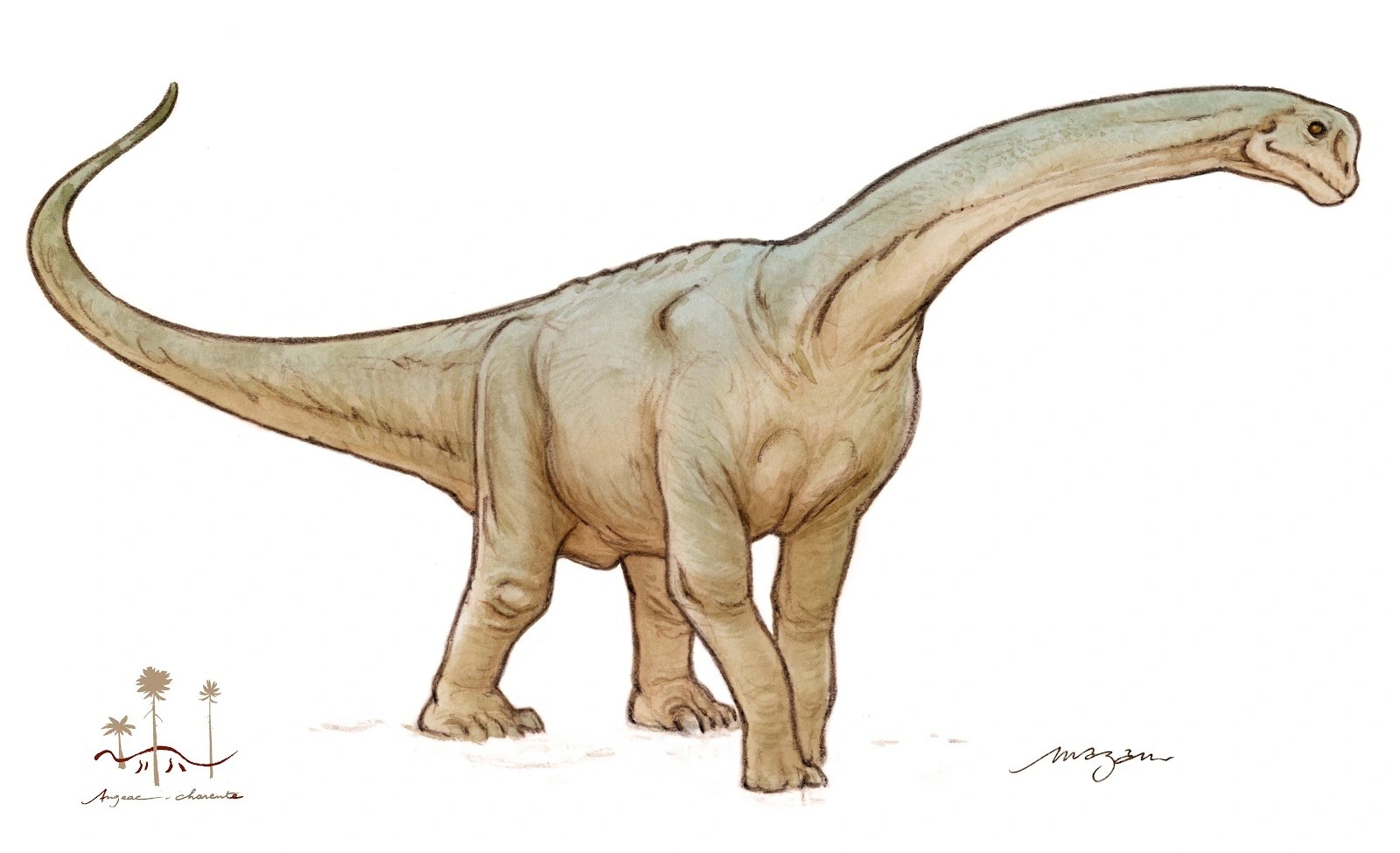
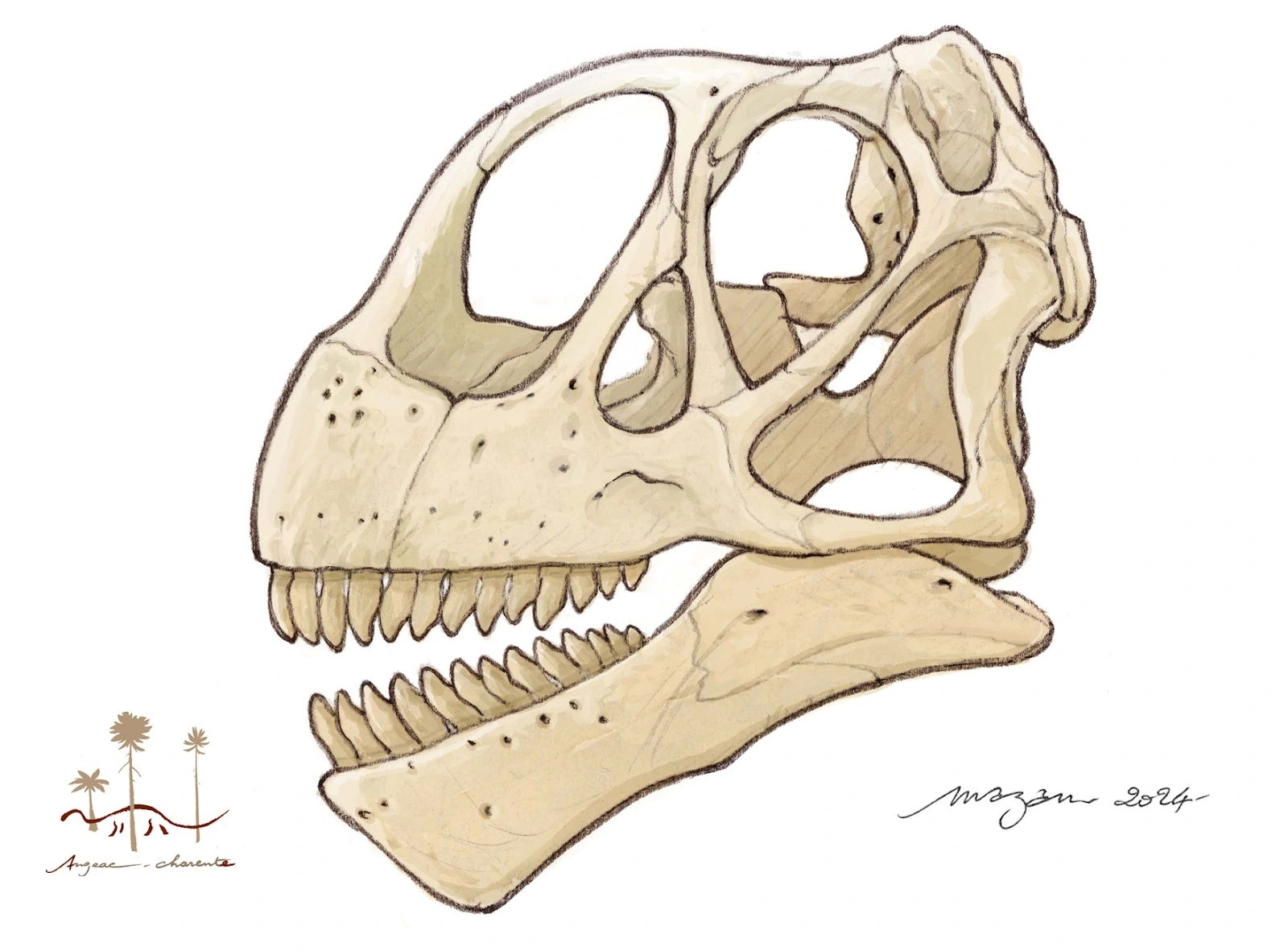
Opening a new excavation area exposed the end of a femur. Within three weeks, the excavators had uncovered part of a sauropod skeleton, with several bones still articulated. Initially thought to be another turiasaur specimen, the animal proved anatomically distinct, particularly in its large, spatula-shaped teeth.
The shape of the teeth, the very broad vertebrae with bifid neural spines and the robust pelvic bones led Ronan Allain to identify a new species close to Camarasaurus, within Macronaria. It is therefore a different sauropod from the turiasaur found since 2010.
By the end of the 2024 season, the excavated remains included four articulated dorsal vertebrae, about twenty ribs, three pelvic bones, a femur, much of the lower jaw and around twenty teeth. Initial estimates place its length at 15–20 metres and its mass at about 30 tonnes. Its relationship to camarasaurs suggests a relatively short neck that could be raised to reach higher vegetation.
What the recovered bones allow us to reconstruct
The skeletal drawing places the recovered bones: vertebrae of the neck, back, sacrum and tail, ribs, shoulder girdle, pelvic bones, femur and lower jaw. In Mazan’s plate below, the elements highlighted in red correspond to the illustrated record of the 2024 and 2025 finds. Parts completed through comparison help reconstruct the whole animal.

A complete skeletal drawing is not a complete skeleton recovered in the field. The label “Camarasauridae indet.” on the drawing indicates a proposed family-level identification, without a determined genus or species. Similarity to Camarasaurus guides anatomical comparisons; it does not replace the scientific description of the new material.
From a protected block to anatomical observation
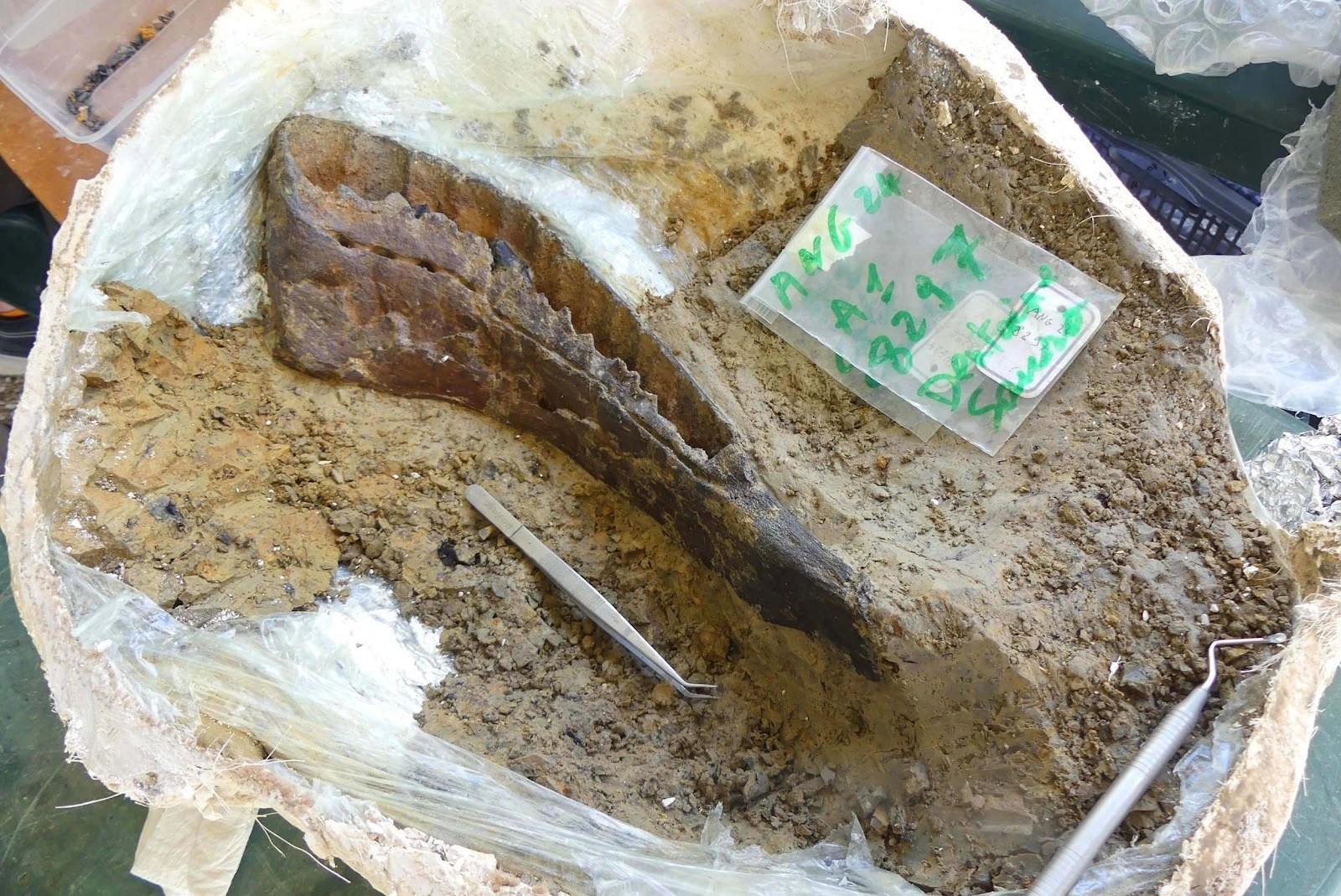
The sketch made at the Musée d’Angoulême in March 2025 shows the ischium, a pelvic bone, and ribs in their block. Before comparing these bones, they must be exposed and stabilised while retaining their numbers and field information. The drawing also documents this stage of the work, between excavation and study.

Reconstructing the giant, bone by bone
Teeth, skull fragments, neck, back and tail vertebrae, pelvic bones, limbs and foot bones allow us to compare different parts of the skeleton. The giant sauropod known since the first field seasons belongs to Turiasauria.
Each new element refines our understanding of its anatomy. A claw from the first toe, discovered after a violent storm in 2013, adds another detail to the animal’s reconstruction.

An animal in its landscape
We study sauropods as part of their whole environment: rivers, wetlands, vegetation and other animals. Reconstructions show the connections between these discoveries and the habitats in which the giants lived.
Reading the tail, vertebra by vertebra
Caudal vertebrae form the tail. Their sequence reveals repeated structures and changes in shape along this part of the skeleton. Researchers also examine articulation surfaces, arches and bony projections: characters used in comparisons between sauropods.

A tooth, patiently reassembled
A tooth’s outline may only emerge after lengthy preparation. This specimen arrived from the excavation in many fragments. Sorted and matched one by one at the museum, they gradually fit together until the crown and the beginning of the root become recognisable.
Reassembly reveals the fossil’s shape without erasing its fractures. Outlines, surfaces and missing areas must remain distinguishable for observation and scientific comparison.

Research published in 2026
Different teeth in the same jaw
The study of 167 isolated teeth from the Angeac turiasaur identifies five morphotypes linked to their position in the jaw. Comparative anatomy and 3D morphometrics work together to classify teeth and resolve ambiguous cases.
Clémence Le Gouellec, Ronan Allain, Jean Goedert, Romain Pintore, Jackson Carter, Rafael Royo-Torres, Dominique Augier and Raphaël Cornette, Journal of Anatomy, 2026.
Specimens and data
From teeth to the giant femur
The diversity of teeth complements the study of large bones. Discovered in 2019, femur ANG19-7000 measures two metres long.
Enlarge each plate to examine labels, specimen identifiers and scale bars.


Scientific research on this topic
- 2026 · Intraspecific and interspecific variation in sauropod teeth from Angeac-Charente (conference contribution)
- 2026 · Heterodonty in turiasaur teeth (article)
